
Most textile exporters who contact me after reading about DPP say the same thing. “I understand what it is now. But I have no idea where to start or what working with someone actually looks like.”
That is exactly what this post answers.
Below is the complete 5-phase process I use to build a DPP compliance system for textile exporters — what happens in each phase, what you need to provide, what you receive at the end, and what realistic expectations look like at every step. No vague promises. Just the actual process.

Phase 1 — Discovery Call and Supplier Mapping
Timeline: Week 1-2
Everything starts with a 30-minute discovery call. In that call we cover your current situation — how many styles you export to EU, which buyers are asking for DPP data, what certifications you already hold, how your documentation is currently managed, and what your supplier relationships look like.
This call is not a sales pitch. It is a diagnostic. By the end of it I know exactly what we are working with and where the biggest gaps are.
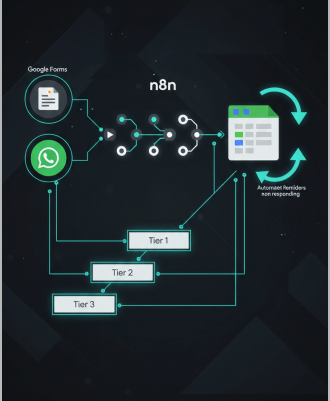
Supplier mapping begins immediately after. An automated data collection system is built using n8n and Google Forms — one form per supplier type, each asking for exactly the data DPP requires. Automated outreach goes to all your Tier 1, Tier 2, and Tier 3 suppliers via WhatsApp and email. If a supplier does not respond within 3 days, the system sends a reminder automatically. No manual chasing needed on your end.
Every piece of incoming data is validated by Claude API — checking for completeness, inconsistencies, and missing fields before it enters the central database in Google Sheets.
Realistic expectation: Tier 2 and Tier 3 suppliers — your yarn spinners, fabric mills, raw material providers — often have never been asked for this information before. Some will respond immediately. Others will need time. The automation handles follow-up, but you need to do one thing in Week 1 — inform your suppliers that data requests are coming from your end. That one conversation makes Phase 1 run significantly faster.
What you receive at the end of Phase 1: A complete supplier database with certification status clearly documented and compliance gaps identified per supplier.
Phase 2 — Compliance Checking and Gap Analysis
Timeline: Week 2-3
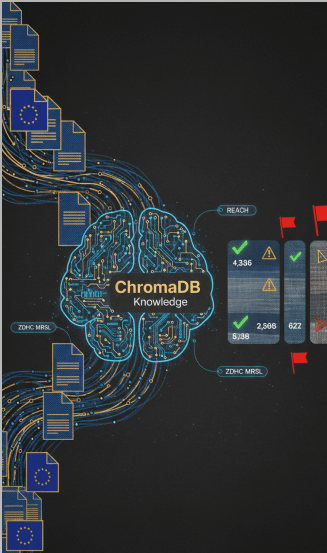
Once supplier data is collected, every style goes through an automated compliance checker. This is a RAG agent — a system built on the actual text of EU DPP regulations. The ESPR regulation, REACH chemical compliance requirements, ZDHC MRSL database, and textile-specific annexes are all loaded into a ChromaDB knowledge base. The agent checks each style against these requirements and generates a compliance score.
The output is a gap analysis report — what each style has, what it is missing, and a priority action list ranked by urgency. A PDF compliance report is generated per style, showing the score and the exact gaps.
Realistic expectation: Not every supplier will have the right certifications on day one. Some may hold OEKO-TEX Standard 100 but not ZDHC MRSL compliance. Some may have no formal certifications at all. This is normal for Pakistani exporters — the EU market has not demanded this level of documentation until now. The gap analysis report is not a failure document. It is a roadmap. Knowing exactly what is missing in Week 2 gives you time to fix it before 2027. That is the entire point of starting early.
What you receive at the end of Phase 2: Compliance score per style, gap analysis report, priority action list, and a PDF compliance report per style.
Phase 3 — Carbon Footprint Calculation
Timeline: Week 3
Every DPP-compliant product needs verified environmental data — and carbon footprint is one of the most important figures EU buyers and regulators will look at.
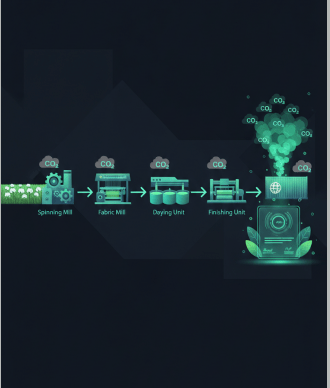
A Python carbon calculator built specifically for textile supply chains processes the data collected in Phase 1. Inputs include fibre type and origin country, spinning and weaving processes, dyeing and finishing methods, washing technique, and transport route to the EU. The output is a kg CO2 figure per garment, broken down by production stage — so you can see exactly where the carbon is coming from.
Each style is compared to the EU industry average for that product category. A carbon footprint certificate PDF is generated per style, along with reduction recommendations — practical changes your supply chain could make to lower the number in future seasons.
Realistic expectation: This is a calculation based on available industry data — not a laboratory measurement. It follows standard methodology used across the global textile industry for DPP compliance purposes. It is accurate enough for EU submission and will improve in precision as supplier data becomes more complete over time. Denim styles will always show higher carbon figures due to the dyeing and washing processes involved. This is expected, documented, and manageable — not something to hide.
What you receive at the end of Phase 3: Carbon footprint certificate PDF per style and a reduction recommendations report.
Phase 4 — QR Code Generation and Digital Passport Pages
Timeline: Week 4
This is where everything becomes real and visible — and honestly, this is the phase clients find most impressive.
Every style gets a unique identifier in a structured format that links it to your factory, product category, year, and batch number. A live passport web page is built for each style using FastAPI — one page per style, hosted and accessible from anywhere in the world.
When an EU buyer, customs officer, or end consumer scans the QR code on your product label, they land on a clean, structured page showing everything: the product name and batch number, full materials breakdown with fibre percentages and origin countries, Tier 1, Tier 2, and Tier 3 supplier names with certification status, carbon footprint figure, chemical compliance status, and recycling and end-of-life instructions.
This is what DPP compliance actually looks like in practice. A German retailer scans your label in their office and sees your entire supply chain verified and documented in seconds. That is a sales advantage, not just a compliance checkbox.
Print-ready QR code PNG files are generated per style — sized correctly for garment labels, hang tags, and packaging. All files are delivered in an organised folder structure by style and batch.
Realistic expectation: The passport page is only as complete as the data from Phases 1 and 2. Styles with full supplier data and certifications get a complete, submission-ready passport. Styles with gaps get a partial passport with a clear compliance roadmap embedded in the page. Both are useful — one is ready for EU submission, the other has a documented path to get there.
What you receive at the end of Phase 4: Print-ready QR code PNG files per style, live scannable passport pages per style, all organised by style and batch.

Phase 5 — EU Registry Submission and Final Delivery
Timeline: Week 5
The final phase brings everything together into submission-ready format. All supplier data, compliance reports, carbon certificates, and passport pages are compiled into JSON data files — the format the EU central DPP registry requires. Every PDF is named and organised according to EU submission standards. An n8n submission workflow is built and ready to execute.
A compliance certificate is issued per style confirming the DPP package is complete. The full handover package is delivered — everything organised, named, and documented so your team can manage it going forward.
Realistic expectation: The EU central DPP registry goes live in July 2026. The submission workflow is built and ready — actual submission happens the moment the registry opens for entries. Being ready before the registry opens means you are first in line, not scrambling at the deadline alongside every other exporter who waited.
What you receive at the end of Phase 5: The complete DPP package per style — supplier database, compliance report, carbon certificate, QR codes, live passport pages, and EU registry submission files. Everything ready.
Ongoing — Monthly Monitoring After Delivery
Delivery is not the end. DPP compliance is a living system, not a one-time project.
After handover, an automated monitoring system runs in the background. Certification expiry alerts fire 60 days before any supplier certification expires — giving enough time to chase renewals without panic. Supplier reminder sequences go out automatically when renewals are due. A compliance dashboard in Google Sheets or Streamlit gives you real-time status across all your styles.
As you launch new styles, they are onboarded into the system using the same pipeline. When EU DPP requirements are updated — and they will be updated as the regulation matures — the monitoring system flags what needs to change.
Realistic expectation: DPP compliance requires ongoing attention. Certifications expire. Suppliers change. New styles launch. The monitoring system means you receive alerts, not surprises. The difference between a brand that stays compliant and one that falls behind is usually just whether they have a system watching for problems before they become crises.
What You Need to Provide
Before we start, I do not need anything formal from you. The discovery call is enough to begin. As the project moves forward, we work through what is needed at each phase together — starting only with what you are comfortable sharing.
Most clients start with just a style list and their direct supplier names. Everything else gets built gradually as the system takes shape and trust develops naturally through the work.
The more complete your starting data, the faster the system delivers results. Clients who arrive with organised supplier lists and existing certifications move through Phase 1 in days. Clients who are starting from scratch with no documentation can absolutely still be served — Phase 1 simply takes a full 2 weeks instead of one. Either way, the system gets built.
What Does the Full Timeline Look Like?
Week 1-2: Discovery call, supplier mapping, automated data collection system built and running.
Week 2-3: Compliance checking, gap analysis reports generated per style.
Week 3: Carbon footprint calculation and certificates generated.
Week 4: QR codes generated, passport pages built and live.
Week 5: EU registry submission files prepared, full handover package delivered.
Ongoing: Monthly monitoring, certification tracking, new style onboarding.
For a brand exporting 10-20 styles to EU, the full process takes 5-8 weeks end to end. Brands with more styles or more complex supply chains — multiple fabric mills, several washing units, mixed fibre sourcing — should expect 8-12 weeks. Both timelines are realistic. Neither is rushed. The goal is a system that works, not a document that looks good on paper.
Is Your Business Ready for DPP?
The brands that will keep their EU buyers in 2027 are the ones building their compliance systems now — not the ones waiting for their buyer to send a compliance questionnaire in late 2026 with a 30-day deadline.
This is not about being perfect on day one. Every exporter I work with has gaps at the start. The point is knowing exactly where your gaps are and having a system that closes them before enforcement begins — not discovering them at EU customs.
If you export to Europe and want to understand where your current compliance stands, book a free 30-minute discovery call. We look at your supply chain, identify your specific gaps, and map out exactly what a complete DPP system looks like for your business.





Leave a comment