
EU Digital Product Passport is coming for textile exporters by 2027. If your mill or clothing brand sells into Europe, this regulation will make or break your market access. Most Pakistani exporters I speak to have never heard of it. The ones who have heard of it are assuming it won’t apply to them, or that it will be delayed again. Both assumptions are dangerous. This is the EU Digital Product Passport, and it will affect every textile exporter by 2027.
What Is the EU Digital Product Passport — In Plain Language
Think of it this way. Right now, a buyer in Germany orders 5,000 metres of fabric from your mill in Faisalabad. They know your price. They know your delivery time. But they have no verifiable way to know where your cotton came from, what chemicals were used in dyeing, how much water was consumed, or what happens to the fabric at end of life.
The EU Digital Product Passport changes that completely. From 2027, every textile product entering the European market must carry a digital record — linked to a QR code or RFID tag — that contains verified information about the product’s materials, origin, sustainability data, and supply chain journey.
This is not a certification you apply for once. It is a living data record that must be accurate, traceable, and accessible at every point in the supply chain — from your factory floor all the way to the end consumer in a shop in Amsterdam or Milan.

Why Pakistani Textile Exporters Will Be Directly Affected by EU Textile Regulations
Pakistan is one of the top textile suppliers to Europe. Bed linen, knitwear, denim, sportswear — enormous volumes move from Karachi, Faisalabad, Lahore, and Sialkot to European retailers every year.
The DPP regulation applies to any product sold in the EU market, regardless of where it was manufactured. If your buyer is a German retailer, a Dutch wholesaler, or a UK brand sourcing from Pakistan, your product will need a compliant passport.
Your European buyers will start asking for this data well before 2027 — because they need time to build it into their own compliance systems. If you cannot provide it, they will find a supplier who can. This is not speculation. It is already happening with larger compliance frameworks like REACH and CBAM. DPP is the next one.

What Happens If You Ignore DPP Compliance 2027
Let me be direct about the business consequences. This is not a fine you pay and move on.
Your shipments can be stopped at EU borders. Customs authorities will have the power to reject non-compliant goods. A container sitting in Rotterdam while you sort out paperwork is a cost you cannot absorb easily — and a relationship with your buyer that may not recover.
Retailers and brands are already updating their supplier qualification criteria. Non-compliant suppliers will simply be removed from approved vendor lists. Not penalised — removed. Quietly replaced by someone who is ready.
And smaller brands, especially those in the modest fashion and athletic wear segments, may find their EU market access closed entirely if they miss this window to prepare.
What You Need to Start Doing Now — Practical Steps for Supply Chain Traceability
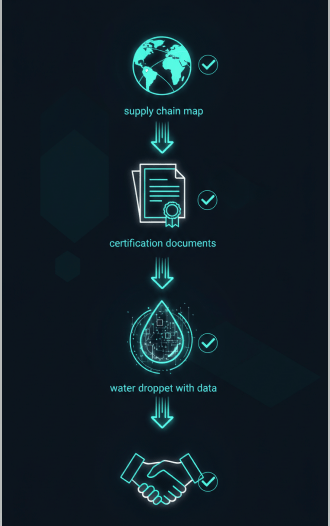
Step 1 — Map your supply chain fully
You need to know every input that goes into your product. Raw fibre source, spinning mill, dyeing unit, finishing, packaging. If any part of this is unclear or undocumented, start building that record now. The DPP requires verified data, not estimates.
Step 2 — Start documenting your material certifications
GOTS, OEKO-TEX, BCI, recycled content percentages — any certifications your suppliers hold need to be collected, stored, and linked to specific production lots. Not just kept in a folder on someone’s desktop.
Step 3 — Understand your water and chemical footprint
The DPP will require environmental impact data. Dyeing and finishing units in particular need to start tracking water usage, chemical inputs, and effluent treatment. This does not need to be perfect from day one — but you need to start capturing it.
Step 4 — Talk to your European buyers now
Do not wait for them to come to you with a compliance questionnaire in 2026. Reach out proactively. Ask what data they will need from their supply chain. This conversation alone positions you as a serious, long-term partner — not a reactive vendor.
How AI Automation Can Help With DPP Compliance
This is where I want to be honest about what is realistic for a Pakistani mill or exporter, versus what is theoretical.
Manual compliance tracking — spreadsheets, emails, PDF attachments — will not scale to DPP requirements. The data volume, the verification requirements, and the need to update records dynamically as products move through the supply chain makes manual systems impractical.
AI-powered automation can handle the heavy lifting. Systems built on tools like n8n, LangGraph, and RAG pipelines can automatically collect supplier data, verify certifications against expiry dates, flag missing documentation, and generate the structured data required for a DPP-compliant digital record.
I have been building exactly these kinds of systems for textile businesses from Karachi. Not theoretical workflows — actual pipelines that connect your supplier data, your production records, and your compliance requirements into one automated system that runs without a dedicated compliance team.
The cost of building this system is significantly lower than the cost of losing one major European buyer because you were not ready.

The window to prepare is 2025 and 2026. Exporters who start now will be ready. Those who wait until the regulation is fully enforced will be scrambling — and some will not make it through that scramble with their buyer relationships intact.
Ready to start your DPP compliance journey?
Book a free 30-minute discovery call. We will look at your current supply chain, identify your compliance gaps, and map out what an automated DPP system would look like for your business.





Leave a comment