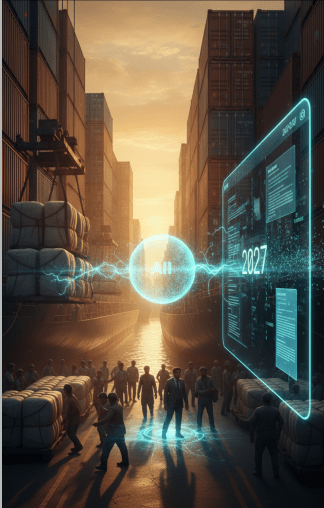
Pakistan’s textile exporters have a problem most of them do not know about yet.
By 2027, every single textile product entering the European Union — every roll of denim, every towel, every knitwear shipment — must carry a Digital Product Passport. A DPP is not a label or a certificate. It is a digital record containing the full story of a product: where the cotton came from, what chemicals touched it, how much carbon was emitted making it, who was in the supply chain, and how it should be recycled at end of life. No DPP means no EU market access. No EU market access means billions of dollars in Pakistani exports stop at the border.
This is not a distant threat. The ESPR regulation framework finalizes in 2025. Pilot programs begin in 2026. 2027 is the hard deadline. And right now, most Pakistani exporters — from the denim mills in Karachi to the towel factories in Faisalabad — are either unaware or overwhelmed.
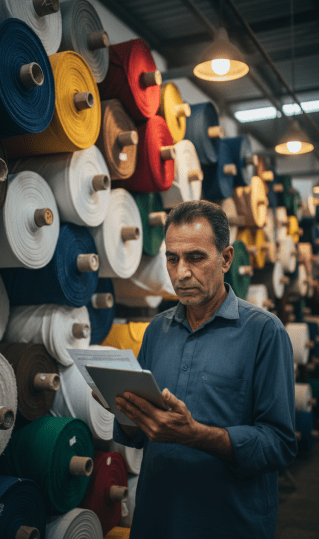
I built DPPBot because this gap is real and the clock is running.
What Pakistan Stands to Lose
Pakistan exports over $14 billion in textiles annually. The EU is one of the largest destination markets. Pakistan also holds GSP Plus status — a preferential trade arrangement that allows zero-duty textile exports to Europe. That status is conditional on compliance with EU standards. DPP non-compliance does not just mean rejected shipments. It means the entire GSP Plus relationship comes under scrutiny.
The certification requirements alone are enough to overwhelm a small or medium exporter. OEKO-TEX Standard 100 tests for harmful substances and costs PKR 80,000 to 200,000. ZDHC Level 2 certification — mandatory for serious denim exporters — requires wastewater testing at approved labs like SGS Pakistan or Bureau Veritas in Karachi, costs around PKR 200,000 in the first year, and takes three to six months. REACH compliance requires chemical testing for over 240 restricted substances. GOTS certification is needed for organic cotton. GRS for recycled fiber. ISO 14001 for environmental management. The list continues.
Most exporters do not know where to start. Most cannot afford to hire a compliance consultant. And most of the official EU documentation is written in regulatory language that assumes familiarity with European legal frameworks.
This is the problem DPPBot solves.
What DPPBot Does
DPPBot is an AI agent — not a chatbot, an agent — that processes compliance questions through an eight-step intelligence pipeline and returns practical, Pakistan-specific answers.
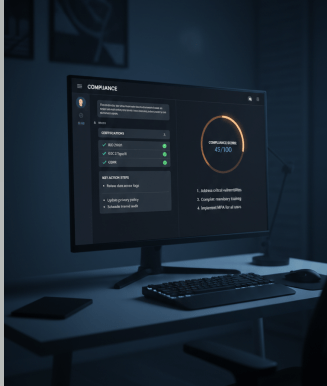
Ask it “I export denim to Germany, what certifications do I need by 2027?” and it does not just answer the question. It identifies your product type, searches a knowledge base of real EU regulations, detects which certifications you are missing, generates a phase-by-phase action plan with costs in PKR, scores your compliance readiness from zero to one hundred, and synthesizes everything into a structured response with lab names in Karachi, timelines in months, and costs your finance team can actually work with.
A score below sixty automatically triggers a consultation booking link. A score above eighty tells you exactly what you already have and what remains.
The knowledge base covers everything a Pakistani exporter needs: ESPR Article 7 requirements, the full REACH restricted substances list, ZDHC certification costs and approved labs, OEKO-TEX and GOTS priority guidance, product-specific requirements for denim, knitwear, home textiles and garments, and a Pakistan-specific guide covering GSP Plus implications, common exporter mistakes, and realistic cost estimates in PKR.
How It Is Built — For the Developers Reading This
The technical architecture is what I want other AI engineers to pay attention to, because the design decisions matter.
DPPBot is built on LangGraph — a framework for building stateful AI agent pipelines. Each of the eight nodes is a discrete function that does exactly one job and passes a shared state object to the next node. Query classifier. Product detector. RAG retriever. Gap analyser. Action plan generator. Compliance scorer. Consultation trigger. Final answer synthesizer. This is not a single prompt sent to an LLM. This is a pipeline where each step builds on the last.
The intelligence comes from RAG — Retrieval Augmented Generation. Six EU regulation files are stored in ChromaDB as vector embeddings using the all-MiniLM-L6-v2 model, which runs locally for free. When a query comes in, ChromaDB finds the most semantically relevant regulation chunks and passes them to Claude as context. This means DPPBot answers from real documents, not from what a language model happens to remember about EU regulations from training data. For compliance work, that distinction is critical.
The entire project runs on three Jupyter notebooks. Notebook one handles setup and data generation. Notebook two builds the ChromaDB knowledge base and RAG pipeline. Notebook three assembles the LangGraph agent. The Streamlit frontend adds the chat interface and compliance dashboard. Total API cost to build and test the entire thing: under one dollar.
Security was built in from the start. All user input is sanitized with bleach before it touches the API or the database. The API key lives in a .env file that never enters version control. Input length is capped. Category outputs are whitelist-validated. These are not afterthoughts — they are part of the architecture.
The Real Situation for Pakistani Exporters Right Now
Here is what I want exporters reading this to understand. The 2027 deadline feels far. It is not. Getting OEKO-TEX certification takes six to eight weeks. ZDHC Level 2 takes three to six months. Building the supply chain documentation that a DPP requires — tracing cotton origin, chemical inputs, supplier records — takes longer than any certification. If you start in 2026 you are already late.
The exporters who move first will have a competitive advantage. EU buyers are already asking for DPP readiness documentation. German and Dutch importers in particular are ahead of this curve. Being the Pakistani supplier who already has OEKO-TEX, already has ZDHC, already has supply chain traceability — that is a sales advantage before 2027 even arrives.
DPPBot does not replace a compliance consultant. It gives exporters the knowledge to have an informed conversation with one, to know which certifications to prioritize, to understand what the costs will be, and to stop being surprised by requirements they could have prepared for.
What This Project Represents
DPPBot is Project 2 in my AI engineering portfolio. Project 1 was TextileBot. Both are built around the same principle — AI should solve real problems for real industries, not just demonstrate that AI can do things.
Checkout Github Repo
The textile industry is where Pakistan’s economy lives. Fourteen billion dollars in exports. Millions of jobs. A trade relationship with Europe that took decades to build. The DPP regulation is coming whether the industry is ready or not.
I would rather it be ready.
If you are a textile exporter navigating DPP compliance, or a developer building industry-specific AI agents, you can find me at iamjunaidiqbal.com.
Junaid Iqbal is a Pakistani AI engineer. DPPBot is open source. Built with LangGraph, ChromaDB, Claude API, and Streamlit.


Leave a comment