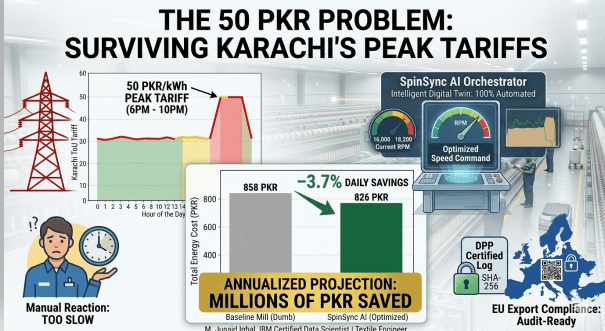
We all know the feeling in the Karachi textile sector when the clock hits 6:00 PM. It’s not just the end of a shift; it’s the start of the Peak Tariff window. Suddenly, every spindle spinning on your floor is costing you nearly double in electricity.
As a Textile Engineer from NED and an IBM Certified Data Scientist, I’ve spent a lot of time thinking about this gap. We have world-class machinery, but we are often fighting 21st-century energy costs with 20th-century manual reactions.
I decided to build a solution: SpinSync AI.
The Goal: Saving Money Without Sacrificing Quality
The challenge in a spinning mill is a “tug-of-war.” If you run too fast during peak hours, your electricity bill kills your profit. If you slow down too much or too suddenly, you risk Ends-Down (breakage) and waste.
I developed an AI Orchestrator—a “Digital Twin” of the shop floor—that balances these two conflicting goals automatically.
How It Works (The Simple Version)
I didn’t want to build a “black box” that no one understands. Instead, I focused on three practical steps:
- Smart Load Shifting: The system “sees” the K-Electric tariff schedule. It doesn’t just shut things off; it intelligently throttles the RPM by about 10% during that expensive 50 PKR/unit window.
- Predictive Safety: Using machine learning, the system monitors vibration and tension. If the risk of yarn breakage (Ends-Down) spikes, it adjusts the speed instantly—faster than any human operator could.
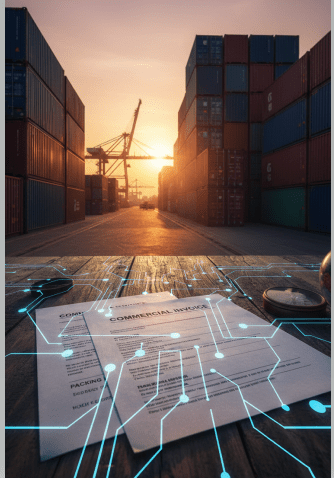
- The “Export Passport”: European buyers (like IKEA or Zara) now want to see “Digital Product Passports.” My system cryptographically signs every hour of production data, proving exactly how much energy was used for every bag of yarn.
Real Results
In my latest simulation, this approach generated an immediate 3.7% reduction in daily energy OPEX. That might sound like a small number until you multiply it by 50 Ring Frames over 365 days. We are talking about millions of PKR in found profit just by being smarter with data.
Explore the Project
I’ve made the entire workflow transparent because I believe in the power of open engineering. You can review the logic, the math, and the results through the links below:
- Download the Full Slide Presentation (PDF) – Great for a quick business overview.
- Read the Technical Documentation (README) – For a deep dive into the “How.”
- Review the Python Code on GitHub – For the developers and data scientists who want to see the engine under the hood.
Let’s Build Something Smarter
The textile industry is changing. With rising energy costs and stricter export regulations, the mills that thrive will be the ones that treat their data as a raw material—just like cotton.
If you’re looking to optimize your production floor, tackle energy challenges, or build digital traceability for your export line, I’d love to chat. Whether it’s a quick brainstorm or a full-scale project, let’s see how we can make your machines work a little harder for your bottom line.



Leave a Reply