(A 6-Minute Read for Textile Engineers & Factory Owners)
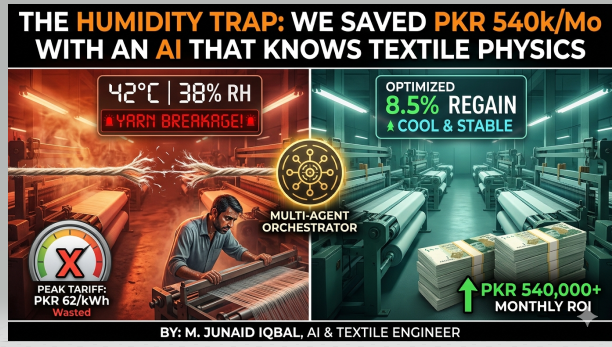
If you are running a weaving shed in Karachi, you know the feeling. It’s 2 PM in June. The ambient temperature outside is pushing 42°C. Inside, the Luwa system is screaming at 100% power.
You walk onto the loom floor. The air feels dry. You touch the warp yarn; it feels brittle, almost like paper. Ten minutes later, snap. A warp break. Then another. Production slows.
At the end of the month, you get the K-Electric bill. It’s astronomical.
This is the “Double Trap” of Karachi textiles: You are spending millions on electricity, yet your yarn is still breaking.
Why the ‘Dumb’ Controllers Are Failing Us
For decades, we’ve relied on standard PID controllers. They are simple: “If Temperature > Setpoint, turn on the Chiller.”
This logic is too simple for Karachi. It doesn’t understand physics. It doesn’t know that Silk (11% Regain) has different humidity needs than Cotton (8.5%). Most importantly, it doesn’t know that K-Electric charges double during peak hours.
These “always-on” systems are reactive. They wait for the shed to overheat before they act. By then, the energy is already wasted, and the yarn quality is already compromised.
We needed a system that doesn’t just react; it needed a system that thinks.
The Loom-Thermal Solution: An AI that Knows Textile Physics
I didn’t want to build just another piece of software. I wanted to build an Operational Partner. As a Textile Engineer who has worked with Data Science, I wanted to bridge that gap.
We built Loom-Thermal, an “Agentic” AI framework designed to run locally on your existing factory computers (no expensive cloud servers required).
Instead of one “dumb” controller, Loom-Thermal uses Two Specialized AI Agents that must negotiate with each other every 15 minutes:
- The Quality Guard (The Textile Engineer): This Agent is dedicated only to protecting the yarn. It uses Hartshorne’s Equations (the gold standard of textile physics) to calculate the exact Moisture Regain of your Cotton or Silk. If the Regain drops by even 0.1%, it demands cooling.
- The Budget Manager (The Accountant): This Agent is dedicated only to saving money. It knows the K-Electric tariff structure. If it’s 7 PM (Peak PKR hours), it will block the high-power Chiller from turning on, pushing the system to use more efficient (and cheaper) Adiabatic/Misting methods instead.
The Magic: The “Orchestration” logic forces these two to negotiate. They find the “Goldilocks Zone”—the single cooling action that uses the absolute minimum amount of energy while guaranteed to protect the 8.5% Yarn Regain.
Stopping Failures Before They Stop Production
We also addressed the “Invisible Enemy” of Karachi mills: Lint Clogging.
Standard sensors don’t notice when a Luwa filter is gradually choking on fluff. They only notice when the shed temperature finally spikes. By then, it’s too late.
Loom-Thermal includes an Anomaly Detection module. If the AI commands “100% Cooling Power” but the Digital Twin predicts the temperature should have dropped but didn’t, it immediately deduces a Filter Clog.
Instead of waiting for a temperature alarm or a yarn break, the system pings the maintenance team with a specific, proactive instruction: “Inspect Luwa Filters Immediately—Efficiency Drop Detected.” This alone can reduce unplanned downtime by 15%.
The Real-World Impact: Proving Value with Data
We didn’t just build the logic; we built an interactive tool to let factory managers simulate the savings themselves.
Using our “What-If” Strategy Dashboard, we modeled a typical 100-loom Karachi shed running Cotton (8.5% Regain).
| Scenario Parameters | Results |
| Loom Count: 100 | Daily Savings: ~PKR 18,000.00 |
| Tariff: PKR 50/kWh | Projected Monthly ROI: PKR 540,000.00 |
| Fiber: Cotton (8.5%) |
That’s half a million PKR per month in found money, simply by using smarter logic.
Explore the Full Project
I believe in transparency and collaboration. I’ve made all the foundational elements of this project available for your review:
- Presentation: You can view the PDF presentation which breaks down the business case and deployment roadmap.
- Documentation: Read the detailed README file for a complete technical overview.
- Code Review: I invite engineers and technical leaders to review the source code on GitHub. (The code is “SQL-Injection Free” and optimized for zero-risk, local-only deployment).
A Human-to-Human Offer
This project is a labor of love. It’s an attempt to take the best of modern Data Science and apply it to the operational challenges of an industry that is the backbone of Pakistan’s economy.
The Loom-Thermal framework is ready for its next phase: a 7-Day Pilot Phase where we can map a specific shed’s thermal footprint.
I am an independent AI and Textile Engineer. My passion is identifying operational bottlenecks—whether they are in humidity control, predictive maintenance, or process optimization—and building the smart, local logic to solve them.
If you are a mill owner or a technical director who is tired of standard “always-on” solutions and wants to discuss how this type of customized, physics-informed logic can optimize your specific production lines (or any other complex operational challenge), I’m available for a chai.
Let’s talk about how we can build something smarter, together.





Leave a Reply