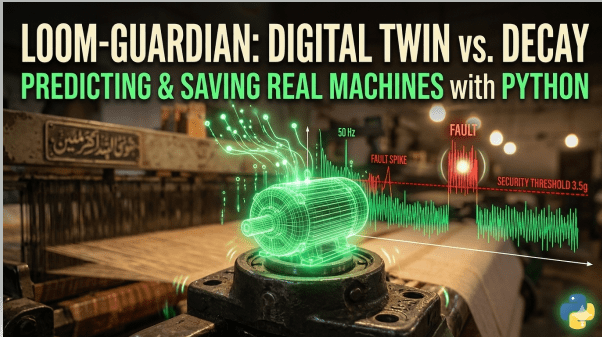
In the heart of an industrial hub like Karachi, the rhythmic “clack-clack” of a textile loom is the sound of the economy moving. But what happens when that rhythm breaks? A single bearing failure or a snapped thread doesn’t just stop one machine—it stalls production lines and costs money.
I recently took on a project called “Loom-Guardian” to solve this using code. I wanted to see if I could build an “AI-lite” system that acts as a 24/7 security guard for these machines. Here is how I did it, and why it matters.
The Challenge: High Speed, Low Power
Industrial sensors generate data every single millisecond. If you try to process all of that on a standard laptop, the system freezes. My goal was to create a “Signal-to-Insight” pipeline that could handle high-frequency data without needing a supercomputer.
The Method: 3 Steps to Machine Intelligence
1. Creating the Digital Twin
I started by writing a Python script to simulate a real loom motor. I didn’t just use a perfect math equation; I added “Industrial Noise”—the random jitter and floor vibrations you’d find in a real mill. This gave me a realistic playground to test my “Guardian” logic.
2. The Frequency “Fingerprint”
Vibration is just a wave. Using a technique called Fast Fourier Transform (FFT), I converted those messy waves into a frequency map. Think of it like a musical tuner: it tells you if the machine is humming a healthy “50Hz tune” or if there is a high-pitched “scream” coming from a broken part.
3. The Secure Agent
Once a fault is detected (like a spike in vibration), the system doesn’t just sit there. I built a “Mock Agent” that triggers an alert. In a real factory, this would automatically order a spare part from the warehouse before the machine even breaks down.
Why This Matters for the Future
This isn’t just about code; it’s about Predictive Maintenance. By catching a 3.5g vibration spike today, we prevent a total machine meltdown tomorrow. It’s about making our industries smarter and our workflows more secure.
Check Out the Work
I’ve documented every step of this journey for anyone interested in Industrial IoT or Signal Processing:
- [GitHub Repository]: You can review my full Python source code and see how I optimized it for mid-range hardware.
- [ReadMe File]: A deep dive into the technical setup and library requirements.
- [PDF Presentation]: A slide-by-slide breakdown of the project’s architectural strategy and results.






Leave a comment