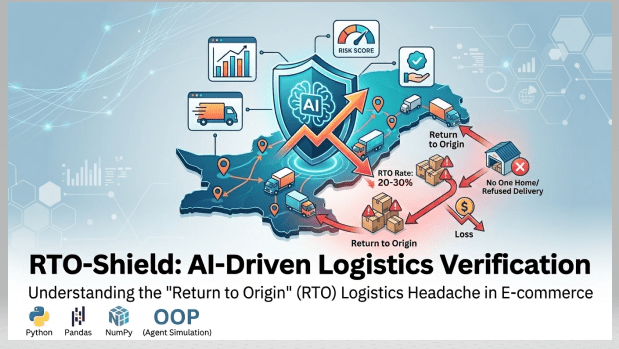
The Problem
E-commerce is booming, but it has a massive, hidden cost. Imagine running an online store, getting an order, carefully packing the product, and sending it out, only for the delivery person to find no one home, a wrong address, or a customer who has simply changed their mind. The package comes back. You’re out the shipping cost—twice. This is called RTO: Return to Origin.
It’s a huge problem, especially in emerging markets. It’s expensive, inefficient, and demoralizing. This project, RTO-Shield, is my attempt to use the power of modern data tools to fight back.
My Simple Idea
The core of the solution is surprisingly straightforward: what if we could predict which orders are most likely to fail before we ever ship them?
If we knew that, we could act. Maybe we call the customer to confirm. Maybe we send a friendly WhatsApp reminder. Maybe, for the riskiest orders, we insist on pre-payment. This is about making the whole process smarter.
My Three-Step Solution (The “Method”)
I didn’t just want to build a theoretical model; I wanted to build a practical tool. So, I used a standard data science approach, but with a few clever twists to make it efficient. Here’s how I did it:
1. The Math of Risk: Vectorized Scoring
First, I created a simple, rules-based risk engine. For example, a “Cash on Delivery” order is generally riskier than a prepaid one. A history of previous RTOs is a major red flag. By assigning a numerical score to these factors, I could calculate a single “Risk Score” for every new order.
The “Pro” Trick: To make this run as fast as possible, I used what’s called “vectorized” math. Instead of checking each order one by one, I told the computer to process all 10,000 orders at once. This keeps the whole system snappy and responsive.
2. Enter the AI: Our Automated Agent
Once we have a risk score, we need to do something with it. I simulated an AI-powered Logistics Agent. Think of it as a smart, robotic assistant that never sleeps. It looks at the risk score and decides on the best next step:
- Low Risk: Automatic approval. Let’s get it shipped!
- Medium Risk: The agent automatically triggers an automated WhatsApp confirmation to double-check with the customer.
- High Risk: The system is flagged for a human check or an automated voice call to confirm the order details.
This way, we are using the automation of AI to handle the scale, but focusing our resources where they’re most needed.
3. Safety First: Data Anonymization
This is crucial. The data used to train and test these models often has real people’s names and phone numbers. It’s an ethical nightmare. Before I did anything else, I wrote code to anonymize this sensitive data. Real phone numbers are masked and names are replaced with random IDs. This makes the project “GitHub-ready” and shows that security is built-in from day one.
The Proof is in the Code
I have built this entire system from scratch using Python. You can see all the logic, from data generation to the AI agent’s rules, in my project repository on GitHub. If you are a recruiter or a fellow developer, I would love for you to review my code and provide feedback.
For a Deeper Dive
This blog post is just the high-level summary. I have prepared much more detailed documentation for you to explore. Click on the links below to learn more:
- 💻 Read the Full Technical ReadMe: [Link to README.md]
- 📊 View the Slide Presentation (PDF): [Link to PDF]
I am excited to share this work with the world. I believe it’s a practical, modern approach to a classic logistics problem, showing how data and AI can make our systems more efficient and trustworthy.
Let’s keep the conversation going! I would be grateful for your thoughts and code reviews on my GitHub project.




Leave a comment