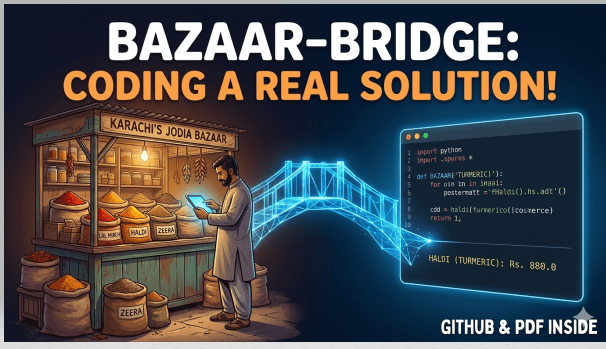
We often think of tech innovation happening in sleek offices or high-tech labs. But some of the most satisfying problems to solve are those right on our doorstep—in the traditional, fast-paced markets that have operated the same way for decades.
I’m talking about places like Karachi’s Jodia Bazaar. If you’ve ever been, you know it’s a sensory overload of sights, sounds, and, most importantly, speed. Wholesalers there have incredibly efficient mental systems, but the sheer volume of transactions and the challenge of managing diverse, sometimes “messy” orders can cause a slowdown.
That’s where the idea for my project, Bazaar-Bridge, came from. I wanted to see if I could build a simple, effective bridge to help these incredible traders manage their orders more easily, all using tools and techniques accessible to anyone with basic coding skills.
And I did it using the same humble, reliable Dell Latitude 5490 that I use for my everyday work!
The Core Problem: A Language Barrier
The first challenge I encountered was one of language and consistency. Orders in Jodia Bazaar come in all shapes and sizes. Sometimes it’s formal English, sometimes straightforward Urdu, and often a mix that we call “Roman Urdu” (Urdu words written using the English alphabet).
For example, a wholesaler might type “Lal Mirhc” instead of the proper “Lal Mirch” (Red Chili), or “Haldee” instead of “Haldi” (Turmeric). Traditional database systems are very rigid; one typo and the item “isn’t found.” This was the biggest friction point I had to address.
My Simple, Effective Solution Method
I knew I needed a system that was robust but also “headless” and “lightweight.” This meant it shouldn’t rely on expensive software or complex graphics. It needed to work quietly in the background, just doing its job.
Here is the straightforward method I used to build the Bazaar-Bridge pipeline:
1. Building the Memory (The Database)
First, I needed a way to store the product lists securely and simply. I chose SQLite. This is a built-in database tool in Python that’s incredibly stable. It doesn’t require complex server setups. It just creates a simple file on my laptop’s disk that stores the data. Think of it as a super-secure, permanent digital ledger.
- Key Consideration: Even in a simple project like this, security matters. Wholesaler rates are protected business secrets. I built the system using parameterized queries, which is a fundamental practice that prevents anyone from “tricking” the database into deleting or showing data it shouldn’t.
2. Designing the Smart Parser (The Typo Fighter)
This was the core challenge. I couldn’t just use standard searching. I needed the system to understand intent.
I used a clever little tool called RapidFuzz. This implements a “fuzzy matching” algorithm. It basically looks at how close two words are. So, when someone types “Lal Mirhc,” the parser instantly says, “Hey, that’s a 90% match for ‘Lal Mirch (Red Chili)’ in our ledger. We’ve found it!”
This single step removed the need for complex AI models on my laptop just to handle simple typos, keeping the whole system incredibly fast and efficient.
3. The Agentic Bridge: Connecting to the Customer
Once the item is securely identified and the correct price retrieved, the next step is crucial: confirming with the customer.
Official WhatsApp Business APIs can be expensive and restricted. My goal was accessibility. I used a method to generate a universal, secure WhatsApp link that pre-fills a professional-looking message.
The seller just clicks the link, and their WhatsApp app opens with a beautifully drafted message (like: “Assalam-o-Alaikum! Bazaar-Bridge Order for Zeeshan: Lal Mirch (Red Chili): Rs. 1320.0”) already typed and ready to send. It’s frictionless, free, and leverages a platform everyone already uses.
Want to Review the Work or Present the Idea?
I’m extremely passionate about solving practical problems with simple, robust tech solutions. I’ve made all the resources from this project openly available for others to learn from, critique, and adapt.
You can find all the components right here:
- Slide Presentation: If you want a quick, visually engaging overview of the problem, solution, and technical architecture, you can view the complete PDF Presentation. (I recommend it for non-technical stakeholders!)
- GitHub Repository (Codebase): For developers and tech enthusiasts, the entire project is open for your review. Please feel free to check out the clean, commented code and the secure database implementation on my GitHub Repository]
- Documentation & Setup: I believe in making projects easy to replicate. I’ve written a comprehensive ReadMe file that explains exactly how to set up the environment, database, and run the pipeline, even if you are just starting with Python.
Concluding Thoughts
Bazaar-Bridge isn’t about the newest, flashest AI model or a complex software ecosystem. It’s about understanding the unique constraints and needs of a real-world market and using fundamental software engineering principles—like security, stability, and intelligent data handling—to solve them.
If you are a student, a developing engineer, or just someone interested in how simple code can make a difference, I encourage you to check out the links above.
I would love to hear your thoughts and feedback! Feel free to connect with me or review the code on GitHub. Let’s keep building bridges!





Leave a comment