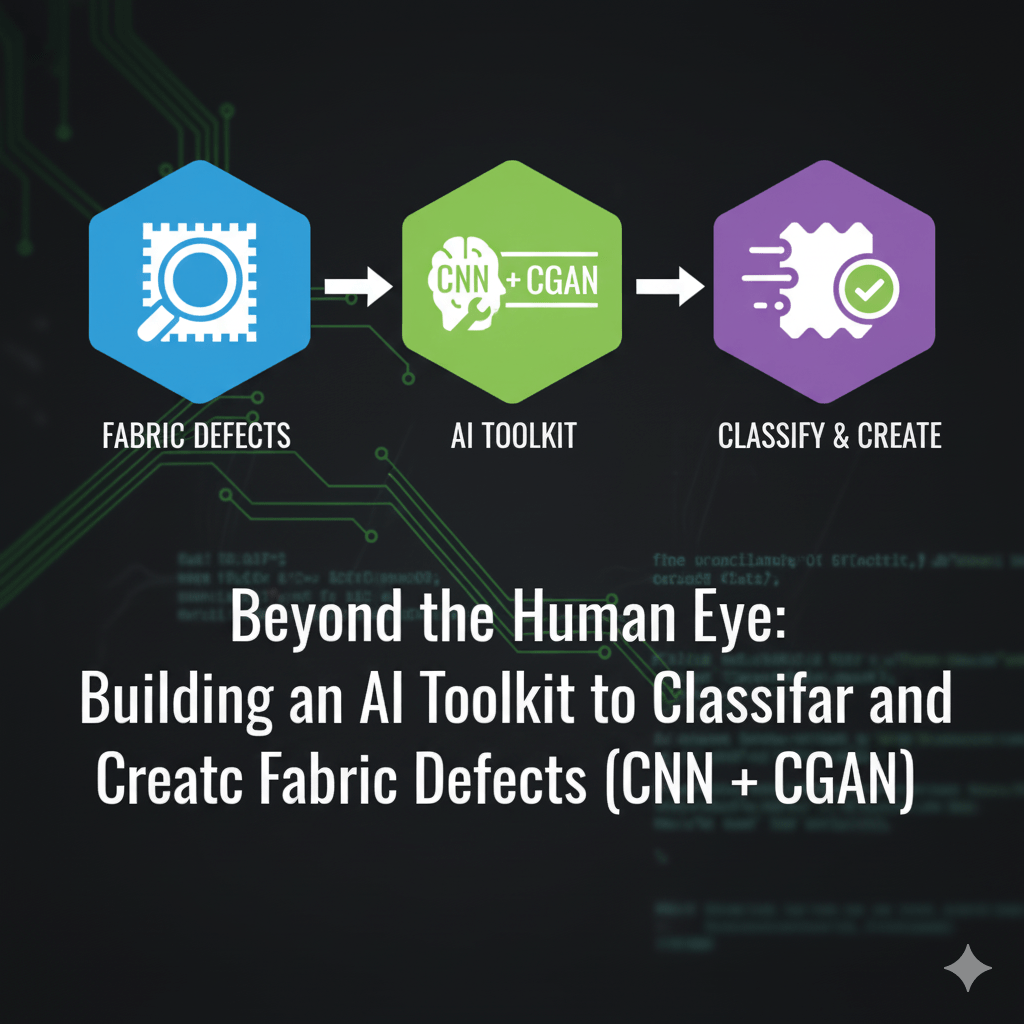
Hey everyone! I just wrapped up a really cool deep learning project that tackles a major bottleneck in textile manufacturing: quality control. Instead of relying on slow, error-prone manual inspection, I built an end-to-end AI system that not only spots defects like holes and lines but can also generate new, synthetic data to make the system smarter over time.
This project, which I call the Fabric Defect AI Toolkit, has two main parts.
1. Part One: The Classifier (CNN) — Teaching the AI to See
The first goal was simple: can a computer accurately tell the difference between four common types of fabric flaws? This is where the Convolutional Neural Network (CNN) comes in.
How the CNN Works
Think of a CNN as a specialized digital eye. I fed it hundreds of images of real defects—things like captured threads, holes, and horizontal/vertical lines.
- Preparation: I organized and cleaned the raw images, ensuring each one was perfectly labeled (e.g., “This image is a ‘hole’”).
- Training: The CNN learned to recognize tiny patterns—the subtle textures, shapes, and contrasts—that define each defect class.
- Result: The finished
fabric_defect_cnn_model.h5model is now a reliable, automatic inspector. It can instantly look at a new piece of fabric and tell you exactly what kind of defect is present, ensuring consistent quality control at high speed.
2. Part Two: The Generator (CGAN) — Making Data Limitless
Here’s the problem every data scientist faces: data scarcity. You can never have enough real-world defect images, and collecting them is tough. My solution? I built an AI that creates its own defects.
This is where the Conditional Generative Adversarial Network (CGAN) becomes the game-changer.
How the CGAN Works
A CGAN is essentially two AIs fighting it out, like a competitive duo:
- The Generator: This network’s job is to create new, fake images that look as realistic as possible.
- The Discriminator: This network’s job is to be the critic, trying to determine if an image is real (from my initial dataset) or fake (from the Generator).
By making them compete over thousands of epochs, the Generator becomes incredibly good at fooling the Discriminator. Crucially, because it’s “Conditional,” I can specifically instruct it: “Generate a ‘hole’ defect,” or “Generate a ‘captured’ thread defect.”
This means I can create endless, high-quality synthetic images to continuously train and improve my CNN classifier, making the entire system robust and future-proof without needing more manual data collection.
Project Conclusion: A Powerful AI Toolkit
This dual system shows how modern deep learning can provide a complete solution for complex problems:
- Detection: The CNN identifies the issue.
- Resilience: The CGAN creates the necessary data to keep the system sharp.
This was a challenging but incredibly rewarding project, especially working through those long CGAN training sessions! I’m really thankful of how the two components work together.
Check Out the Code!
All the Python scripts, model definitions, and setup files are available right here on GitHub:
➡️ View the Fabric Defect AI Toolkit on GitHub
I’d love to hear your thoughts on the approach or any suggestions for optimization!




Leave a comment