
Introduction
Cryptocurrency, especially Bitcoin, has captivated the world with its wild price swings and potential for massive returns. But beyond the headlines, what’s really driving Bitcoin’s behavior? In this blog post, we’ll dive deep into a comprehensive Bitcoin analysis project that uncovers fascinating insights into its price trends, trading volume, and the inherent volatility that defines this digital asset. Whether you’re a seasoned trader or just crypto-curious, understanding these dynamics is crucial. We’ll explore everything from long-term Bitcoin price prediction challenges to the hidden patterns within the data itself.
If you’re interested in the details, all the project code, the full presentation, readme file and the raw data are available on my GitHub
The Rocket Ride and Rollercoaster of Bitcoin Prices
Bitcoin’s journey has been nothing short of extraordinary. Imagine a rocket launching into space, then hitting a few bumps along the way – that’s a good analogy for Bitcoin’s price history. Our analysis, spanning from 2015 to 2022, reveals some jaw-dropping statistics. We’re talking about a price surge of roughly 60x! To put that into perspective, the Compound Annual Growth Rate (CAGR) was around 130% over those 7 years.
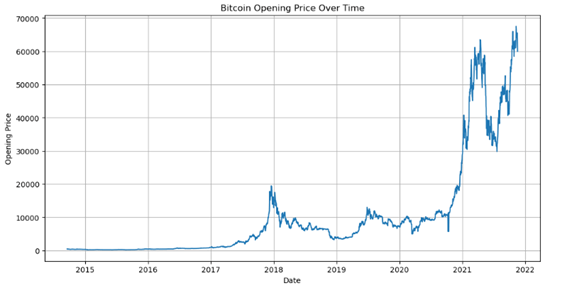
Of course, it hasn’t been a smooth ride. We’ve witnessed epic bull runs, like the one in late 2017 that propelled Bitcoin to around $20,000 and the 2021 surge to nearly $69,000. But these highs are often followed by stomach-churning bear markets with drawdowns of 30-50% – a stark reminder of crypto’s volatility. Even the COVID-19 crash in 2020 briefly pushed Bitcoin below $5,000.
Our analysis also breaks down Bitcoin’s price action into key phases, from its early adoption days to the influence of institutional investors and more recent market factors. For traders, this translates into potential strategies like buying in “halving” years or being cautious when technical indicators flash overbought signals.
Decoding Bitcoin’s Trading Volume: The Fuel Behind the Fire
Price is only one side of the coin; trading volume tells the rest of the story. Think of volume as the fuel powering Bitcoin’s price movements. Our research highlights some dramatic shifts in Bitcoin trading volume between 2015 and 2022.
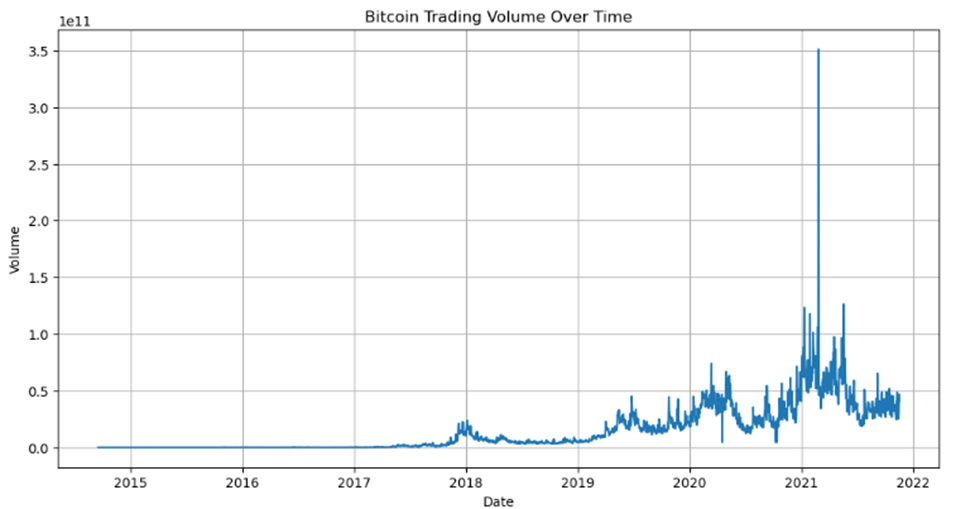
In the early years, daily trading volume was relatively low (below $1 billion). Fast forward to 2020-2021, and we saw an explosion, with volume surging to over $50 billion daily! Interestingly, the subsequent price drop in 2022 was mirrored by a decline in volume – a phenomenon known as the “crypto winter.”
We also observed a strong correlation between volume spikes and price peaks, suggesting that increased trading activity often accompanies major price movements. However, there are anomalies too, like the 2020 COVID crash, where we saw a volume spike without a corresponding price surge, indicating panic selling.
Understanding the relationship between volume and price can provide valuable insights for traders. For example, rising volume alongside rising prices can confirm an uptrend, while rising volume with falling prices might signal a distribution phase.
Distributions, Correlations, and Volatility: Dissecting Bitcoin’s DNA To truly understand Bitcoin, we need to dig deeper into its statistical properties. Our analysis included examining price distributions, correlations, and volatility.
- Price Correlations: Opening, closing, high, and low prices are almost perfectly correlated with each other. This suggests that for some analytical purposes, using just one of these price points might be sufficient.
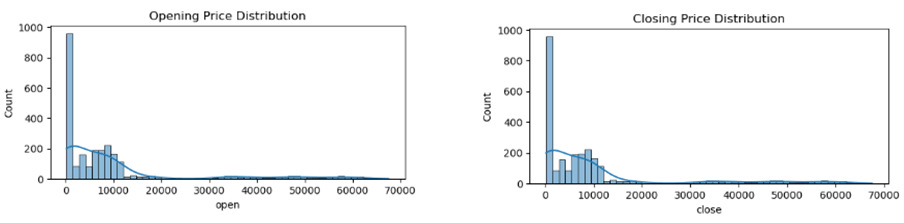
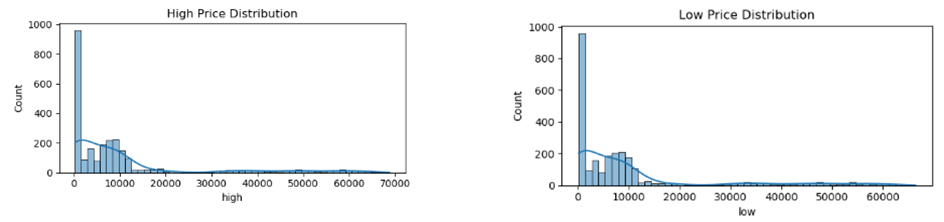
- Right-Skewed Distributions: Bitcoin’s price distributions are heavily right-skewed, meaning that most price occurrences are at the lower end, with fewer instances of very high prices. This long tail in the distribution highlights Bitcoin’s potential for significant price swings.
- Volume Correlation: Trading volume shows a moderate to strong positive correlation with price. In simpler terms, higher trading volume often accompanies higher prices.
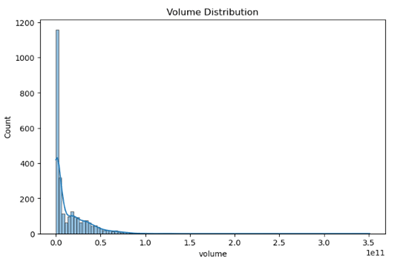
- Volatility is Key: Bitcoin’s volatility is not constant; it fluctuates significantly over time. We observed a massive volatility spike around 2021, emphasizing the inherent risk associated with Bitcoin trading.
Peering into the Future: Bitcoin Price Forecasting Challenges
Can we predict Bitcoin’s future? We put two different models to the test: Prophet and Random Forest.
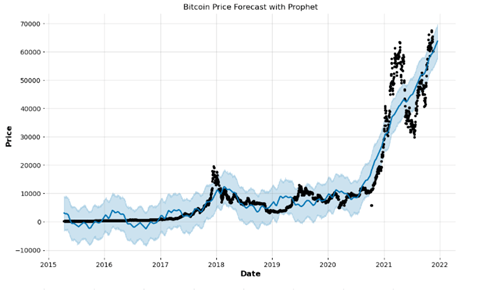
- Prophet’s Perspective: The Prophet model does a decent job of capturing the overall upward trend of Bitcoin’s price. However, it tends to smooth out short-term volatility, meaning it might not be the best tool for predicting those rapid price spikes and dips.
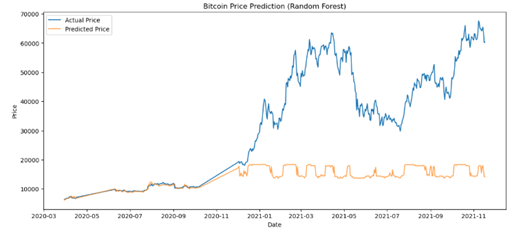
Random Forest’s Reality Check: The Random Forest model struggled to accurately predict Bitcoin’s price, especially during periods of high volatility. In fact, during certain periods, the predictions became almost flat, highlighting the challenges of using traditional machine learning for this type of time series forecasting
Unmasking the Anomalies: When Bitcoin Behaves Strangely
Our analysis also delved into Bitcoin anomaly detection, identifying those unusual price movements that deviate significantly from the norm.
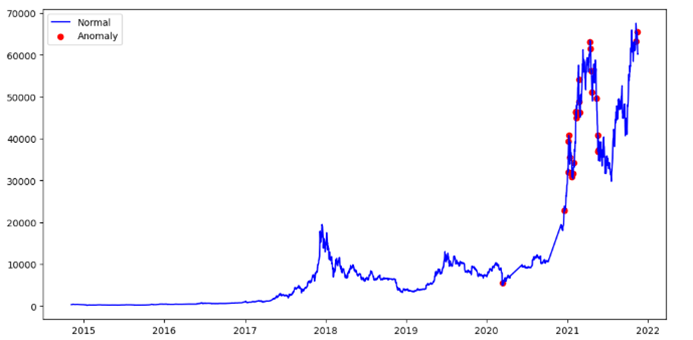
Interestingly, we found that these anomalies tend to cluster during periods of rapid price changes and near price peaks. This suggests that our anomaly detection method is quite sensitive to volatility and potential market turning points. In a live trading environment, these anomalies could act as warning signals for traders.
Conclusion:
This Bitcoin analysis project has provided a comprehensive look at the intricate dynamics of Bitcoin’s price and volume. We’ve confirmed its overall upward trend, but also highlighted its inherent volatility and the challenges of accurate Bitcoin price forecasting.
Here are some of our key cryptocurrency insights:
- Bitcoin prices exhibit a strong upward trend but are characterized by high volatility.
- Trading volume is highly variable and often concentrated in short periods.
- Accurate price forecasting is challenging, especially during volatile periods.
- Identifying anomalies can be crucial for risk management and understanding market behavior.
For traders and investors, understanding these factors is paramount. While Bitcoin offers immense potential, it’s crucial to approach it with a clear understanding of its risks and limitations. Further research into more sophisticated forecasting models and real-time anomaly detection systems is essential for navigating this exciting and ever-evolving market.





Leave a comment